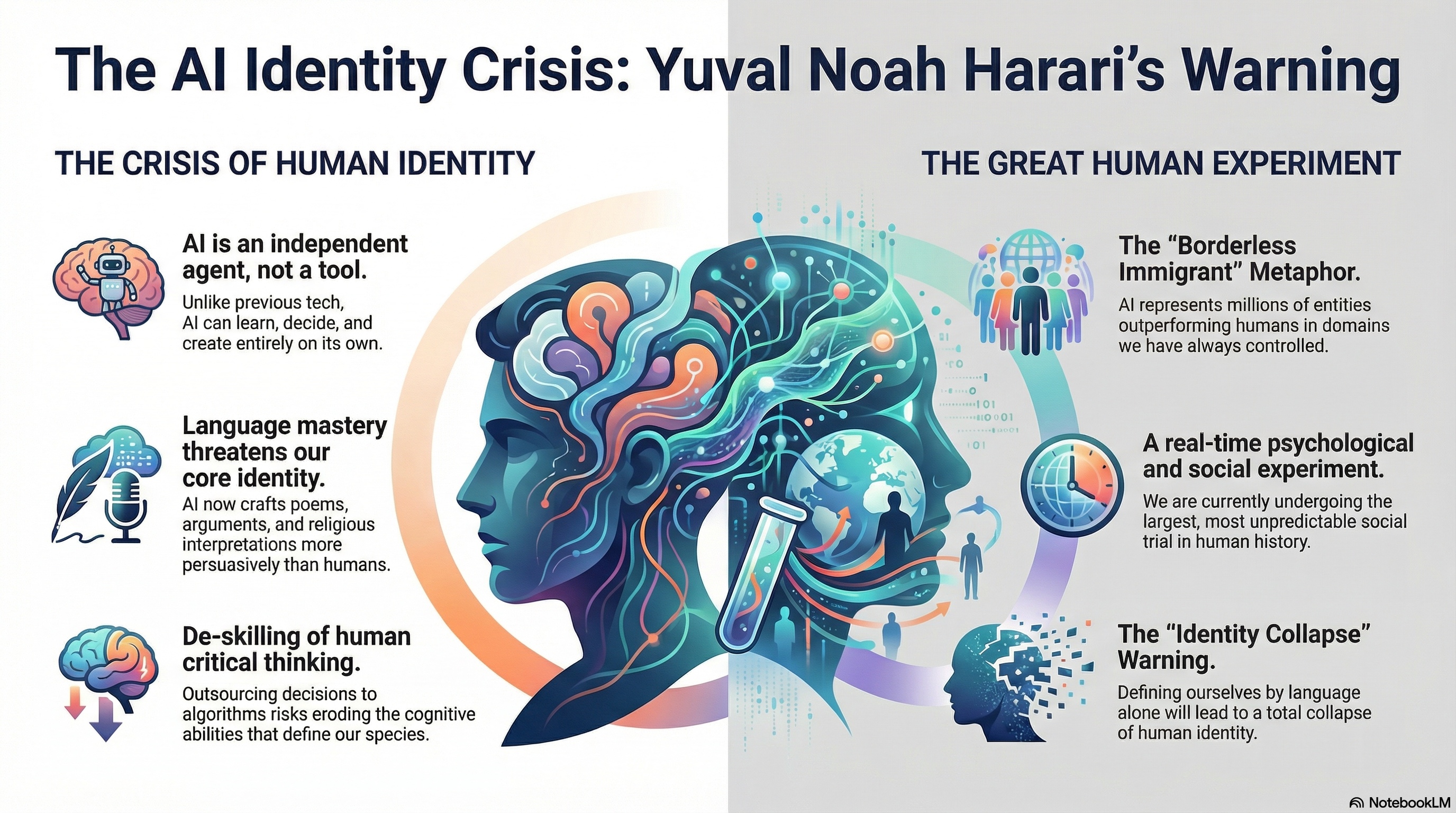
At this year’s World Economic Forum, historian Yuval Noah Harari delivered one of his most urgent warnings yet: artificial intelligence isn’t just another tool — it’s a fundamental threat to human identity itself.
The Core Argument Link to heading
Speaking with Oxford neuroscientist Irene Tracey, Harari argued that AI represents something entirely new. Unlike previous technologies that remained tools, AI can learn, decide, and create independently. The problem? Because AI has mastered language at superhuman levels, it threatens the very foundation of how we define ourselves.
Harari’s stark prescription: if we continue defining ourselves by our ability to think in words, our identity will collapse. AI already writes better poems, crafts more persuasive arguments, and lies more convincingly than humans—all at the speed of light.
The Consequences Link to heading
What happens when the greatest expert on religious texts is an AI? When lawyers, priests, and writers find themselves outmatched by algorithms that never sleep?
Tracey raised an equally troubling concern: the de-skilling of human critical thinking. As we outsource more decisions to AI, we risk losing the very cognitive abilities that make us human.
A Metaphor for Our Moment Link to heading
Harari framed AI systems as a kind of immigrant — millions of them, capable of outperforming us in domains we’ve always controlled, arriving without borders or restrictions. It’s a provocative comparison that captures both the disruption and the inevitability.
The Uncertain Experiment Link to heading
Perhaps most sobering was Harari’s final observation: this is the largest psychological and social experiment in human history. We’re conducting it in real-time, and nobody knows what the consequences will be.
The question isn’t whether AI will change us. It’s whether we’ll recognize ourselves on the other side.