If you’re living in Japan — whether you’re an expat, teacher, engineer, or just someone building a life here — you’ve probably heard about NISA. It’s one of the best perks the Japanese government offers for growing your money without the usual ~20% tax bite on profits.
What Is NISA? Link to heading
NISA stands for Nippon Individual Savings Account — basically Japan’s version of a tax-advantaged investment account, similar to a Roth IRA (US) or ISA (UK).
Launched in 2014 and massively upgraded in 2024 as New NISA, it’s designed to encourage regular people (not just the wealthy) to invest long-term and build assets tax-free.
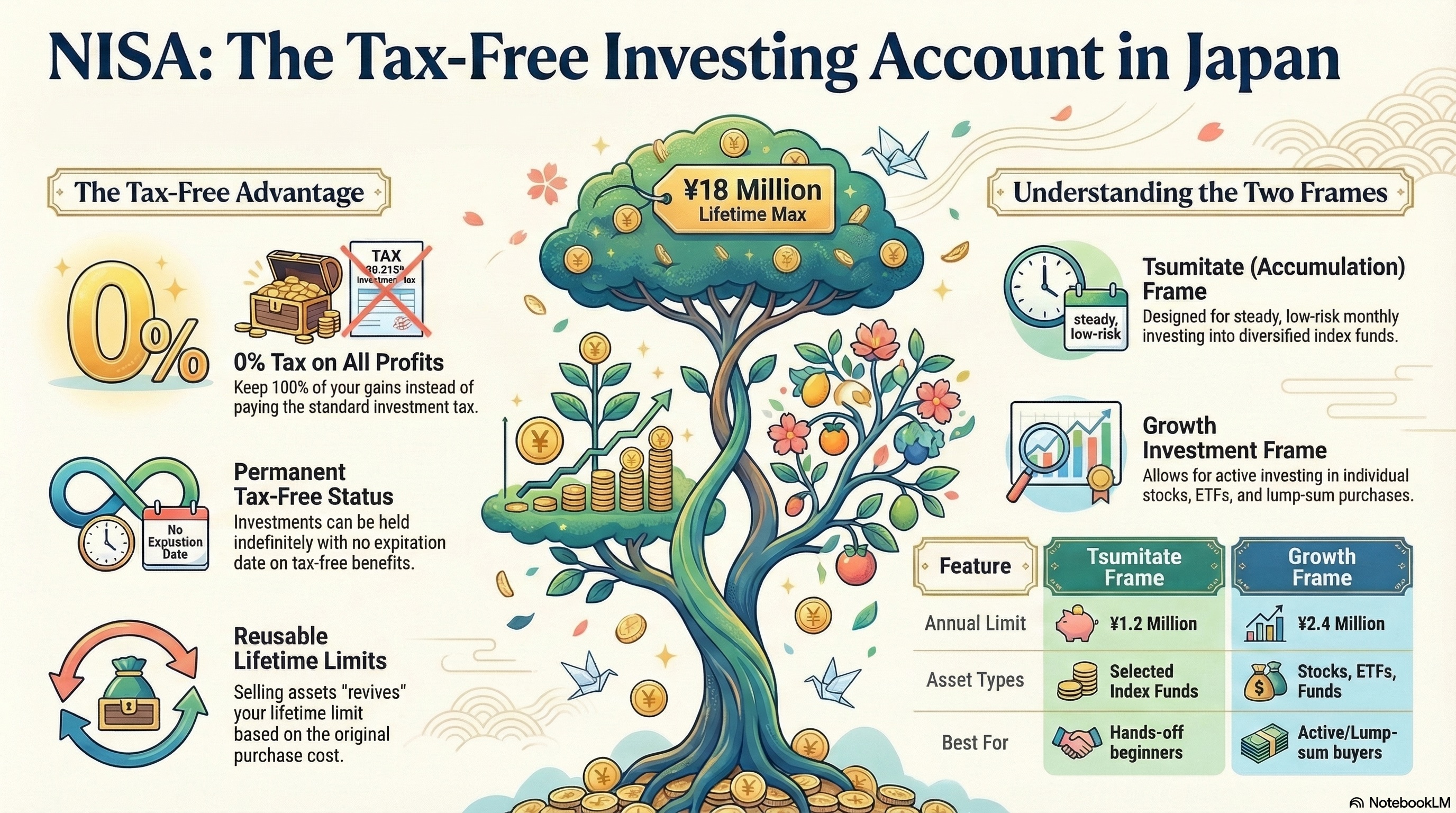
The key upgrade in New NISA: It’s now permanent (no end date), with an unlimited tax-free holding period. You can invest, hold for decades, and never pay tax on gains or dividends — as long as you follow the rules.
The Huge Tax Benefit Link to heading
Outside NISA, Japan taxes investment profits (capital gains from selling stocks/funds + dividends) at about 20.315%.
Inside NISA? 100% tax-free FOREVER.
Example: Invest ¥1 million, it grows to ¥2 million → you keep the full ¥1 million profit (vs. losing ~¥200,000 to tax normally). Over 10–20 years, this compounds massively.
The Two Frames: How New NISA Works Link to heading
You get two separate “frames” you can use together in the same year:
-
Tsumitate Investment Frame (つみたて投資枠 – Accumulation/Installment Frame)
- Annual limit: ¥1.2 million (about ¥100,000/month)
- Best for: Steady, hands-off investing (e.g., monthly auto-debits into low-cost index funds or ETFs)
- Focuses on long-term, diversified, low-risk products approved by the FSA (Financial Services Agency)
-
Growth Investment Frame (成長投資枠)
- Annual limit: ¥2.4 million
- Best for: More active choices like individual Japanese/international stocks, ETFs, or broader funds
- Allows lump-sum buys or one-time investments
Combined annual max: ¥3.6 million (¥1.2M Tsumitate + ¥2.4M Growth)
Lifetime non-taxable limit (total purchase cost): ¥18 million (of which Growth max ¥12 million)
Important: Limits are based on acquisition cost (what you paid), not current value. If you sell assets, that amount “revives” for reuse next year (based on original cost).
Unlimited Time – No Rush to Sell Link to heading
Unlike older versions (5–20 year limits), New NISA lets you hold investments indefinitely tax-free. Perfect for retirement planning or passing wealth on.
Who Can Open a NISA Account? Link to heading
- Age 18+ as of January 1 of the year you start using it
- Must be a resident of Japan (for foreigners with a valid residence card)
- Foreigners on work/husband/spouse visas qualify as long as you’re legally residing here
- Only one NISA account per person (but you can switch brokers/securities firms once per year)
No citizenship required—just residency. Many expats use popular online brokers like SBI Securities, Rakuten Securities, or Monex.
What Can You Invest In? Link to heading
- Tsumitate: Curated low-cost investment trusts/funds (mostly index funds tracking global/Japanese markets—great for beginners)
- Growth: Wider range—Japanese stocks, foreign stocks, ETFs, mutual funds
- Exclusions: High-risk stuff like certain derivatives, monthly-distribution heavy funds, or short-term products
How to Open a NISA Account Link to heading
- Choose a broker/bank: SBI, Rakuten, or major banks (e.g. SMBC, MUFG)
- Open a regular securities/bank account first (if you don’t have one)
- Apply for NISA online (takes 10–30 minutes; need My Number + residence card)
- Link your Japanese bank account
- Start investing (transfer money in, buy funds/stocks)
Tip: Do this early in the year to maximize your annual limit. If you’re new, start with Tsumitate for simplicity.
Important Risks & Reminders Link to heading
- No loss protection: NISA shields taxes, not market drops. Stocks/funds can fall—only invest what you can afford to hold long-term
- Diversify and think long-term (the system’s designed for that)
- If you leave Japan permanently, check rules—some brokers allow keeping the account, but tax status might change
- Pre-2024 old NISA holdings stay separate (different rules/limits)