🕒 AS OF 2026
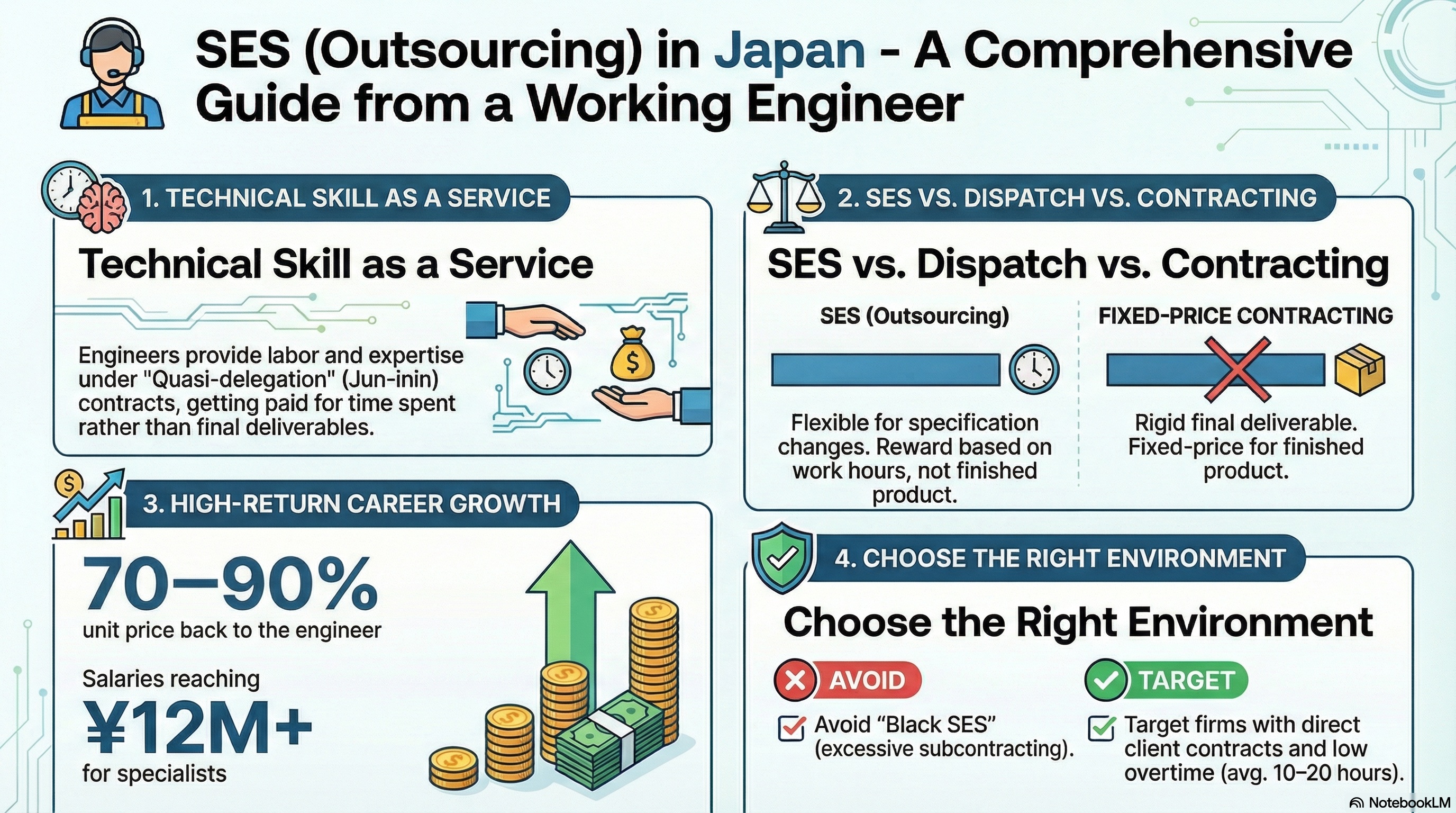
SES (System Engineering Service) is one of the more popular paths for engineers looking to start or accelerate their careers in Japan’s IT sector. But it often raises questions: Is the pay lower? Is it just like being a temp worker?
I will break down everything you need to know about SES from an engineer’s perspective, covering:
- What the work actually involves
- The real advantages and disadvantages
- Salary expectations
- Career paths and long-term prospects
What Is SES — and What Does the Contract Actually Mean? Link to heading
SES stands for System Engineering Service. In practice, it means an engineer employed by an SES firm is placed at a client company for a defined period, providing technical skills and labor on that client’s projects.
The contractual basis is typically a quasi-mandate agreement (準委任契約 in Japanese law), which is broadly similar to a time-and-materials or staff augmentation arrangement in Western markets. Compensation is tied to hours worked, not deliverables. Crucially, the engineer is not liable for project outcomes — they’re expected to perform their duties diligently, not guarantee a finished product.
The SES firm employs the engineer (usually as a full-time or contract employee), then deploys them on-site or remotely to clients. The engineer gets stable pay and benefits through their employer while gaining experience across a variety of projects and industries.
How SES Fits Into the Broader IT Contract Landscape Link to heading
IT projects in Japan, and to varying degrees across Asia, typically operate under one of three contract structures. SES falls under the middle category:
| Contract Type | Purpose | Who Gives Instructions | Compensation Basis | Liability |
|---|---|---|---|---|
| Fixed-Price / Turnkey | Deliver a finished product | Vendor manages internally | Deliverable | Full responsibility for completion |
| SES (Quasi-Mandate) | Provide technical skills | SES firm (in principle) | Hours worked | Diligent execution only |
| Temporary Staffing | Provide headcount | Client directly | Hours worked | Labor provision |
Think of SES as closest to staff augmentation or IT consulting in Western terms — you’re billing for expertise and time, not a guaranteed outcome. This makes it more flexible than fixed-price contracts when requirements shift or problems arise mid-project.
Japan’s IT Subcontracting Structure and Where SES Fits Link to heading
Japan’s system development industry is built on a layered subcontracting hierarchy. A typical chain looks like this:
Prime contractor (major SIer) → First-tier subcontractor → Second-tier subcontractor → SES firm
SES firms tend to operate toward the bottom of this chain, filling in on downstream work: implementation, testing, and operations & maintenance. Their core value proposition is plugging skilled people into projects quickly, which is particularly critical given Japan’s chronic IT talent shortage.
SES vs. Temporary Staffing: An Important Legal Distinction Link to heading
This distinction trips up a lot of people, so it’s worth clarifying.
In both SES and temp arrangements, an engineer physically works at a client site. The critical legal difference is who holds the authority to direct the engineer’s work:
- In a temp arrangement, the client legally directs the worker. This is governed by labor dispatch law, which comes with significant regulatory requirements.
- In an SES arrangement, the SES firm (in principle) retains that authority. The engineer is there to provide expertise, not simply follow the client’s operational orders.
In practice, the line gets blurry — and this is where disguised employment (偽装請負) becomes a legal risk. If a client is de facto telling an SES engineer “do this task today” or “stay late tonight,” that starts to look like illegal labor dispatch regardless of what the contract says.
SES vs. SIer: What’s the Difference? Link to heading
| SES Firm | SIer (System Integrator) | |
|---|---|---|
| Contract basis | Quasi-mandate (time & skills) | Primarily fixed-price (deliverables) |
| Liability | Execution only | Full: delivery, quality, timeline |
| Project role | Support / subcontractor | Prime contractor or direct client |
| Engineers | Deployed to client sites | In-house development or project oversight |
The short version: SIers take on whole systems as a responsibility. SES firms fill skill gaps. A large SIer might hire an SES firm to supplement headcount on a specific technical area during crunch periods.
Employment Relationship: How Engineers Are Hired Link to heading
The most common arrangement is that SES engineers are full-time employees of the SES firm. They receive a consistent salary, social insurance, paid leave, and continued employment even when moving between client projects.
Some engineers operate as freelance SES contractors, working under quasi-mandate agreements directly. This can mean a significantly higher take-home rate (since there’s no employer margin), but no employment benefits or safety net between contracts.
What Does an SES Engineer Actually Do Day-to-Day? Link to heading
Work tends to be weighted toward downstream phases of development, particularly earlier in a career:
- Detailed design and coding
- Testing and debugging
- Operations, monitoring, and maintenance
- Technical support and documentation
- Project coordination (path to upstream work as seniority grows)
Entry-level engineers often start on testing and QA, then move into development and eventually design roles as they accumulate experience. The variety of client environments accelerates this progression compared to staying in one company’s internal team.
The Real Advantages of Working in SES Link to heading
Accessible entry point. Many SES firms actively recruit and train career changers, making it one of the more realistic ways into the IT industry without prior experience.
Rapid, broad skill development. Rotating through different clients, industries, and tech stacks in a short period gives SES engineers a portfolio of experience that would take far longer to build in a single-company role.
Networking. Engineers build genuine professional relationships across multiple organizations — valuable for future job searches or freelance transitions.
Increasing earning potential. The rise of high-return SES firms (those passing back 70–90% of the client billing rate to the engineer) has made SES significantly more lucrative than it was a decade ago.
Some degree of project choice. Better SES firms give engineers input into which projects they take on, which matters a lot for long-term career direction.
The Real Disadvantages Link to heading
You rarely see the full picture. Working on one slice of a large system means it’s easy to lose sight of the product as a whole.
Career narrative can feel fragmented. Jumping between clients makes it harder to point to a single sustained achievement.
Weak company identity. When you spend most of your time at a client’s office, it’s hard to feel connected to your actual employer. This is a genuine cultural challenge in the SES model.
Bench risk. If there’s a gap between client placements, some firms reduce pay during that period. Always clarify a firm’s policy on bench pay before signing.
Salary Expectations Link to heading
SES compensation is essentially: client billing rate × return rate × utilization. The higher the rate a firm can bill, the more it passes on to you, and the less time you spend on the bench, the more you earn.
Approximate salary ranges (gross annual):
| Experience Level | Typical Work | Salary Range |
|---|---|---|
| Entry to 3 years | Testing, operations | ¥3M – ¥4.5M (~$20K–$30K USD) |
| 3–5 years | Development, design | ¥4.5M – ¥6.5M (~$30K–$44K USD) |
| 5–8 years | Cloud, full-stack, team lead | ¥6.5M – ¥9M (~$44K–$61K USD) |
| 8+ years (specialist/PM) | AI, architecture, project management | ¥8M – ¥12M+ (~$54K–$81K USD) |
Note: USD conversions are approximate and for reference only.
What pushes compensation higher:
- Firms with 70–90% return rates and transparent billing (increasingly common)
- Specialization in AI, cloud infrastructure, or cybersecurity — areas commanding a ¥1M–¥2M premium on billing rates
- Firms offering guaranteed bench pay and reasonable overtime
The biggest pitfall is ending up at a firm deep in a subcontracting chain where each layer clips a margin — leaving the actual engineer with a fraction of what the client is paying.
Long-Term Prospects: Is SES Still Worth It? Link to heading
Japan is projected to face a shortage of 790,000 IT professionals by 2030, which keeps demand for SES services structurally strong. While AI and automation are reducing the volume of routine testing and basic coding work, they’re simultaneously creating strong demand for engineers who can integrate AI systems, handle architecture decisions, and operate at the upstream end of projects.
For engineers who invest in skills — particularly in cloud platforms, AI tooling, and system design. SES remains a high-ceiling career path.
Where Do SES Engineers Go from Here? Link to heading
SES works best as a deliberate phase, not a permanent destination. Common exit paths include:
Moving to an SIer or in-house tech team. Brings more project ownership, greater stability, and typically cleaner career progression.
Going specialist within SES. Senior engineers with deep expertise in specific domains can command high billing rates and significant income without ever leaving the SES model.
Going freelance. The natural evolution for many experienced SES engineers — retaining 80–90% of billing rates with full autonomy over project selection.
Pivoting to AI consulting or product development. Increasingly viable for engineers who’ve accumulated relevant skills across multiple client environments.
A Few Things Worth Knowing Before You Sign Link to heading
Disguised employment is a real risk. If a client is directly telling you what to work on and when, day-to-day, that’s legally closer to dispatched labor than SES — regardless of the contract. This is a gray area in Japanese labor law, and if it goes wrong, the SES firm bears liability, not you. But it’s worth understanding the distinction so you know when something feels off.
Read the contract carefully. A proper SES contract should clearly define: scope of work, compensation terms, confidentiality obligations, intellectual property ownership, and termination conditions. Vague contracts tend to produce disputes.
Understand your position in the subcontracting chain. If you’re three layers down from the end client, a significant portion of the billing rate is being absorbed before it reaches your paycheck. Firms that work directly with clients (or one step removed) are generally better for compensation and career development.
Working Hours and Overtime: What to Actually Expect Link to heading
SES contracts typically define a monthly hours band (commonly 140 to 180 hours), based on a standard 40-hour week, and your base salary is fixed within that range. What actually happens in practice depends heavily on the client and project.
💡 I’ve almost never worked overtime till now.
Contractual baseline. Japanese labor law sets the standard at 8 hours per day, 40 hours per week. Most SES contracts include a settlement range (e.g., 140–180 hours/month), meaning hours within that band are covered by your fixed salary. This often includes a deemed overtime allowance (みなし残業) — a set number of overtime hours baked into your pay regardless of whether you actually work them.
Average overtime in practice. Across the IT industry, overtime typically runs 16–19 hours per month. Within SES specifically:
- Better-managed placements (large enterprises, remote-heavy roles): often under 20 hours of overtime per month.
- Poorly-managed placements (deadline-driven projects, multi-layer subcontracting): can exceed 30–50 hours per month, sometimes with unpaid “service overtime” (サービス残業) expected as the norm.
The overtime pay problem. Because SES operates under a quasi-mandate framework, hours worked beyond the contracted range should be billable to the client and in turn, compensated to you. In practice, engineers are sometimes pressured to absorb overruns through effort rather than raising a billing adjustment. Combined with fixed overtime allowances that don’t fully cover actual hours, unpaid overtime is a documented issue at some firms.
What drives the variation:
- Multi-layer subcontracting creates deadline pressure that cascades down to the engineer on the ground, normalizing long hours.
- Placements at large corporations or government agencies tend to have stricter labor management and less overtime.
- The shift toward remote work has broadly improved work-life balance across the industry, and Japan’s Work Style Reform legislation has pushed overall overtime figures downward.
High-pressure projects can accelerate skill development, but they come at a cost. When evaluating firms and placements, it’s worth asking directly about typical working hours and checking whether overtime is consistently compensated or quietly absorbed.
The Bottom Line Link to heading
SES is neither a dead end nor a guaranteed fast track. It’s a tool and like any tool, the results depend on how deliberately you use it.