💡AS OF February, 2026
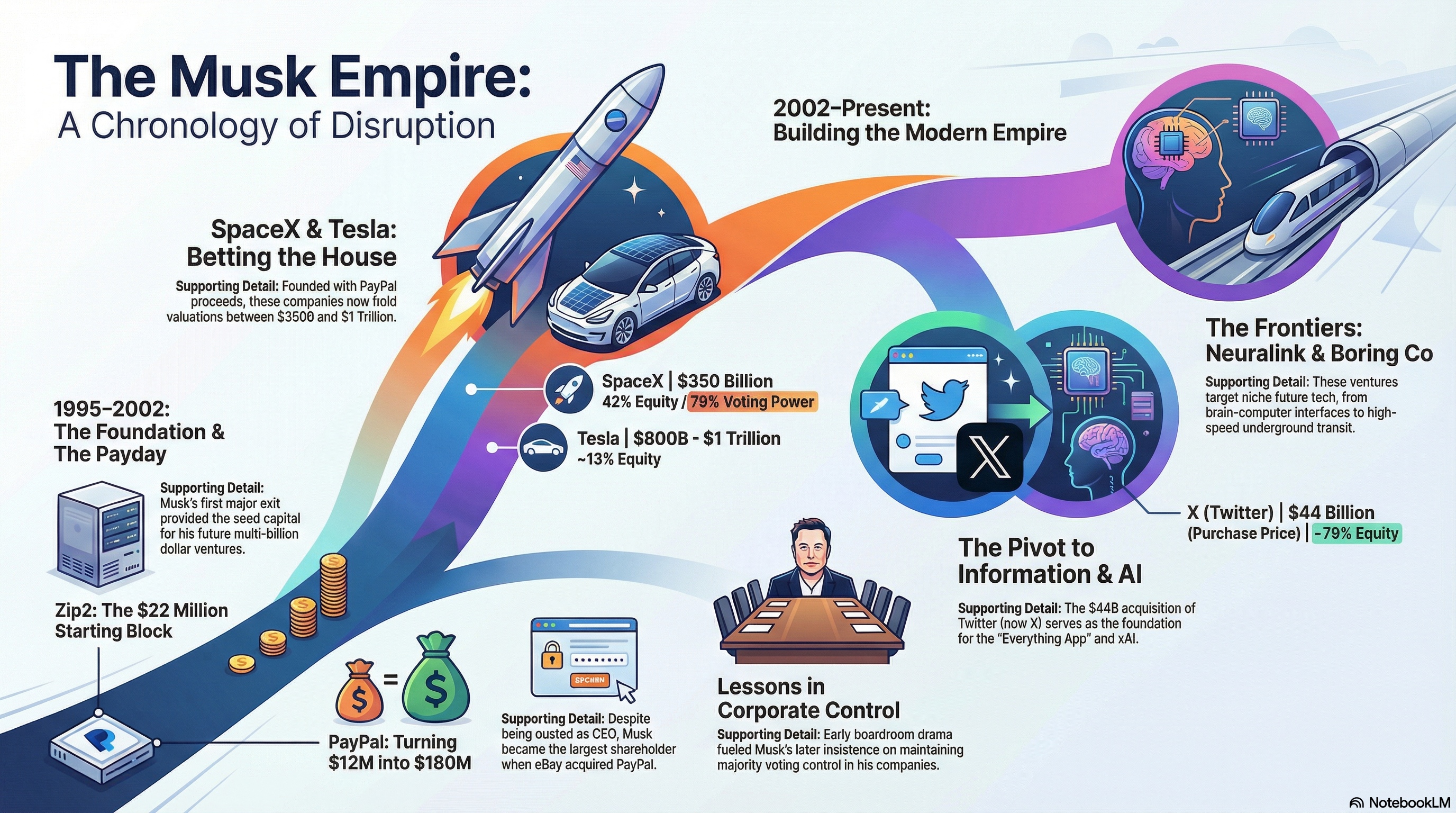
When you think of Elon Musk today, you probably picture rockets landing themselves, Cybertrucks on the road, or chaotic tweets about AI. But the story of how he got here from a scrappy startup coding in an office where he slept is wilder than you might think.
Let’s walk through every major company Elon has touched, from the ones that made his first millions to the ones aiming to put humans on Mars (and chips in our brains).
🌐 Zip2 (1995-1999): Where It All Started Link to heading
The Concept: Back when the internet was still figuring itself out, Elon and his brother Kimbal built Zip2 — software that created online city guides for newspapers. Think early Google Maps meets Yelp, but for the ’90s.
The Numbers: Compaq bought Zip2 for $307 million in 1999. Elon, who held a 7% stake, walked away with roughly $22 million at age 27.
The Reality Check: Elon wrote much of the code himself and literally lived in the office, showering at the local YMCA. Investors brought in a “real CEO” and sidelined him from day-to-day operations — a pattern that would repeat.
Fun Fact: His first major startup exit taught him something valuable: he didn’t want to be pushed aside again. It’s why he’s fought so hard for control in his later companies.
💳 X.com / PayPal (1999-2002): The $180 Million Lesson Link to heading
The Concept: Elon took his Zip2 money and started X.com, an online bank. It merged with Confinity (which had a product called PayPal), and after some corporate drama, PayPal became the name everyone knew.
The Numbers: eBay acquired PayPal for $1.5 billion in 2002. As the largest shareholder with 11.72%, Elon netted about $180 million.
The Drama: While Elon was on his honeymoon in 2000, the board ousted him as CEO. He was replaced but remained the largest shareholder. The experience was reportedly humiliating and galvanizing.
Fun Fact: Elon never let go of the “X” branding. Two decades later, he’d buy Twitter and rename it X Corp. The man holds a grudge (or really loves that letter).
🚀 SpaceX (2002-Present): Betting It All on Rockets Link to heading
The Concept: Frustrated that NASA had no plans to go to Mars, Elon literally tried to buy decommissioned Russian ICBMs to launch mice to the Red Planet. When Russian rocket engineers laughed at him, he decided to build his own rockets.
The Numbers: Founded in 2002 with $100 million of his PayPal money. Today, SpaceX is valued at approximately $350 billion and dominates the global launch market. Elon owns about 42% equity and controls 79% of voting power through a dual-class share structure.
The Journey: SpaceX nearly went bankrupt in 2008 after three failed launches. The fourth launch succeeded just in time, and NASA awarded them a $1.6 billion contract. Now they launch more rockets than entire countries and are building Starship — the vehicle meant for Mars.
Fun Fact: Elon has stated he wants to die on Mars. “Just not on impact,” he jokes. The company’s entire mission is to make humanity multiplanetary, which sounds insane until you realize they’re the only company successfully landing and reusing orbital rockets.
🔋 Tesla (2004-Present): The EV Revolution Link to heading
The Concept: Make electric cars cool, then make them affordable, then change the entire auto industry.
The Numbers: Market cap has swung from $25 billion to over $1.2 trillion at its peak. Currently valued around $800 billion to $1 trillion depending on the week. Elon owns roughly 13%, worth over $100 billion.
The Controversy: Elon wasn’t a founder — Martin Eberhard and Marc Tarpenning were. But Elon led the Series A funding in 2004, became chairman, then CEO in 2008 during the financial crisis. After a legal settlement, he’s officially recognized as a co-founder.
The Rollercoaster: Tesla nearly died multiple times. In 2008, Elon put his last money into keeping it alive. The Model S almost never shipped. “Production hell” became a meme. But Tesla survived, thrived, and forced every automaker on Earth to go electric.
Fun Fact: Elon famously slept on the factory floor during Model 3 production ramp-up, tweeting at 2 AM about manufacturing challenges. Love him or hate him, the man commits to the bit.
☀️ SolarCity (2006-2016): The Family Business Link to heading
The Concept: Elon’s cousins, Lyndon and Peter Rive, founded SolarCity with Elon as chairman and major investor. The idea was to make solar panels as easy as a phone plan — no upfront cost, just a lease.
The Numbers: Tesla acquired SolarCity for $2.6 billion in 2016 in a controversial all-stock deal.
The Drama: Shareholders sued Elon for self-dealing, arguing he bailed out a failing company he was invested in. Elon defended himself in court and won, arguing it was always part of Tesla’s master plan to become an integrated sustainable energy company.
Fun Fact: The trial transcripts are genuinely entertaining. Elon got testy with the lawyer, said he doesn’t respect the SEC (calling them the “Shortseller Enrichment Commission”), and explained his vision for energy independence like he was pitching a sci-fi novel.
🕳️ The Boring Company (2016-Present): Traffic Jams and Flamethrowers Link to heading
The Concept: Elon was stuck in LA traffic and tweeted, “I am going to build a tunnel boring machine and just start digging…” People assumed it was a joke. It wasn’t.
The Numbers: Valued at around $5.7 billion. Elon owns roughly 90%+.
The Reality: The Boring Company has built a few tunnels (including the Las Vegas Convention Center Loop), but hasn’t yet revolutionized transportation. Critics say it’s just a worse subway. Fans say give it time.
Fun Fact: To raise money, Elon sold 50,000 “flamethrowers” (technically “Not-A-Flamethrowers” for legal reasons) for $500 each. They sold out instantly. Elon Musk sold flamethrowers to fund a tunnel company. That sentence is real.
🧠 Neuralink (2016-Present): Chips in Brains Link to heading
The Concept: Build a brain-computer interface so humans can compete with AI. Also help people with paralysis, blindness, and neurological conditions.
The Numbers: Valued between $5 billion and $8 billion. Elon is the majority owner.
The Progress: The first human received a Neuralink implant in January 2024. The patient, Noland Arbaugh, has been able to control a computer cursor and play video games using only his thoughts.
The Vision: Elon talks about “consensual telepathy” and “symbiosis with AI.” It sounds like science fiction because it is — except they’re actually doing it.
Fun Fact: Early demos involved a pig named Gertrude and a monkey playing Pong with its mind. The internet had feelings about both.
🤖 OpenAI (2015-2018): The Breakup Link to heading
The Concept: Elon co-founded OpenAI as a nonprofit to ensure AI development stayed safe and open-source.
What Happened: Elon donated roughly $50 million, then left the board in 2018, citing conflicts with Tesla’s AI work. OpenAI later restructured as a capped-profit company and created ChatGPT.
The Aftermath: Elon now criticizes OpenAI regularly, saying it abandoned its open-source mission. He’s called it “ClosedAI” and accused it of being captured by Microsoft.
Fun Fact: This breakup directly led to Elon founding xAI — his own AI company to compete with the one he helped create. It’s messy, petty, and very on-brand.
🐦 X Corp / Twitter (2022-Present): The $44 Billion Impulse Buy Link to heading
The Concept: Elon bought Twitter, claimed it was to save free speech, gutted the company, rebranded it to X, and turned it into his personal playground.
The Numbers: Purchased for $44 billion (with $13 billion in debt). Elon owns about 79% after taking it private.
The Chaos: Elon tried to back out. Twitter sued him. He went through with it. He fired 80% of staff. He reinstated banned accounts. He made verification a paid feature. He changed the algorithm. He moved the company to Texas. He renamed it X.
The Vision: Elon says X will become “the everything app” — payments, messaging, social media, all in one. Think WeChat for the West.
Fun Fact: Elon showed up to Twitter HQ carrying a sink and tweeted “let that sink in.” I’m not saying he planned the takeover just to make that joke, but I’m not saying he didn’t.
🤖 xAI (2023-Present): Grok and the AI Wars Link to heading
The Concept: Build an AI that “seeks maximum truth” and isn’t “woke.” Compete directly with OpenAI, Google, and Anthropic.
The Numbers: Valued at roughly $50 billion after recent funding rounds. Elon is the majority owner.
The Product: Grok — an AI chatbot trained on X/Twitter data, marketed as having “a rebellious streak” and fewer content restrictions.
The Ambition: xAI is building massive GPU clusters (reportedly one of the largest in the world) to train frontier AI models. Elon believes whoever controls AI controls the future.
Fun Fact: “Grok” comes from Robert Heinlein’s sci-fi novel Stranger in a Strange Land, where it means to understand something deeply and intuitively. Also, Elon thinks it’s funny.
The Bottom Line Link to heading
Elon Musk currently runs six major companies: SpaceX, Tesla, X, xAI, Neuralink, and The Boring Company. His estimated net worth fluctuates wildly with Tesla’s stock price but hovers around $400 billion, making him the richest person in history by some measures.
He’s been ousted, sued, mocked, and nearly bankrupted multiple times. He’s also launched more rockets than most countries, forced the auto industry to go electric, and put chips in people’s brains.
And he’s not done yet.